On Christmas Eve, somewhere in the world, a seven-year-old asks before falling asleep: “How does Santa visit every house in one night?” Adults wave the question away with “magic” and move on. The ones who can’t sleep, it turns out, are the adults. If magic is required, exactly how much magic are we talking about?
Physics is not generous with Santa. This article puts that ungenerousness into precise numbers.

INPUT
Variable 1: Global population of children aged 0–14,
According to the UN World Population Prospects 2024, the global population aged 0–14 is approximately 2.0 billion.[1] This is the central estimate; uncertainty is within ±2%.
Variable 2: Fraction of households that celebrate Christmas,
The Pew Research Center’s 2025 projections put the global Christian population at roughly 2.3 billion as of 2020 — about 29% of the world total.[2] This article uses that figure as a baseline for “households that observe Christmas,” but adds a small margin upward to account for non-Christian families who celebrate culturally, settling on . This is deliberately generous to Santa: we are slightly overstating the pool of eligible households.
Variable 3: Fraction of children on the “nice list,”
Santa mythology holds that only well-behaved children receive gifts. There is, however, no reliable statistical dataset defining “nice.”[3] This article runs both (everyone qualifies) and (30% excluded) side by side.
Variable 4: Children per household,
Combining UN and OECD household statistics, the global average is roughly 2.5 children per household.[4] This sits between the developed-country average (~1.5) and the sub-Saharan Africa average (4+).
Variable 5: Habitable land area,
FAO land-use data, excluding Antarctica and extreme deserts, puts habitable land area at approximately km².[5] This article uses km² for convenience — a conservative figure that slightly understates the area and therefore slightly overstates household density, which works in Santa’s favor.
Variable 6: Dwell time per household,
Down the chimney, deposit the gift, eat a bite of cookie, back up and gone. One second is already far below anything a human body can physically accomplish.[6] And yet, as the [FORMULA] section will show, this “1 second” turns out to be the single most devastating variable in the entire calculation.
Variable 7: Available time window,
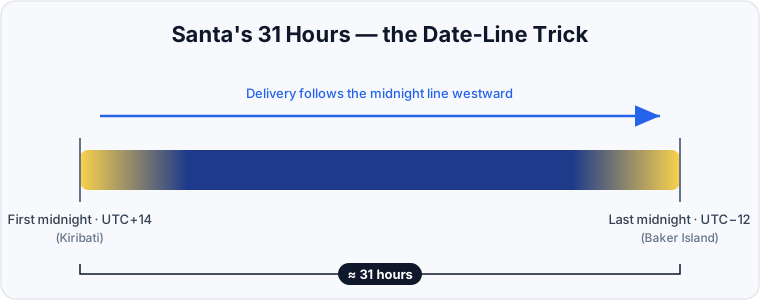
Starting at the International Date Line (UTC+14, parts of Kiribati) and sweeping west to UTC−12 (Baker Island), Christmas Eve is present somewhere on Earth for up to 31 hours.[7] This is the “Santa trick” — riding the midnight line westward to squeeze out every available minute.
Variable 8: Aerodynamic constants
These constants appear only in the air-friction and heating calculation. In order: sea-level atmospheric density, frontal cross-section of the sleigh, drag coefficient, and the specific heat of air at constant pressure. Sources are cited in [FORMULA] Step 7.
FORMULA
Step 1: Number of households to visit
The number of households Santa must visit, , is:
Scenario 1 (, no filters):
Scenario 2 (, religion filter only):
Scenario 3 (, religion + nice-list filter):
Step 2: Total flight distance,
Assume households are distributed uniformly over habitable area . The average spacing between neighboring households is then:
Santa’s total route — visiting every household exactly once along the shortest possible path — is an instance of the Travelling Salesman Problem (TSP). The approximate total distance under uniform distribution is:[8]
This follows directly from . Unit check: ✓
The exact TSP optimum carries a coefficient of 0.7124, which we have simplified to 1.[8] This means our — and the speed and energy derived from it — are overstated by roughly 40%. Removing that 40% does not change the order of magnitude of the conclusion (speeds in the thousands of times the speed of sound).
Total distance by scenario:
For reference, the Earth–Sun distance is km.[9] Scenario 2’s total flight path is roughly equal to the distance from Earth to the Sun.
Step 3: Required flight speed,
Ignoring dwell time and considering travel alone:
Unit check: ✓
Compared to the speed of sound (0.343 km/s at sea level)[10] and the speed of light (299,792 km/s):[11]
| Benchmark | Scenario 1 | Scenario 2 | Scenario 3 |
|---|---|---|---|
| × speed of sound | ~7,400× | ~4,100× | ~3,440× |
| Fraction of light speed | ~0.845% c | ~0.47% c | ~0.39% c |
Step 4: Total dwell time
Let’s pause the speed story for a moment.
No matter how fast Santa flies between houses, he still has to spend at each one. The total dwell time for a single Santa, , is:
Converting from seconds to years using :
Twist 1: Setting flight speed to infinity doesn’t help. Even at 1 second per house, a single Santa’s total dwell time runs from 5 to 25 years. The available window is 31 hours. The bottleneck is not speed — it is dwell time.
Step 5: The paradox of the nice list
Going from Scenario 1 to Scenario 3, the number of households shrinks by a factor of:
A 4.61× reduction in households — shouldn’t speed drop by 4.61× too? No. Total distance scales as , so the speed reduction is only the square root:
Cutting 78% of the world’s children from the delivery list reduces the required speed by just a factor of ~2.1. You remove more than three-quarters of your customers and get slightly better than a halving of effort.
Twist 2: No matter how aggressively Santa manages the nice list, the travel distance between far-flung households shrinks slowly — by the square-root rule. Even eliminating 90% of recipients only reduces speed by . The nice list does not save Santa nearly as much as it seems like it should.
What if we push the filter to its absolute extreme? “Santa Claus Is Comin’ to Town” (1934) warns: “You better not pout.” If only children who had not pouted once in the entire year qualified, that number might be vanishingly small worldwide. Let’s take the extreme: just 10 children.[12]
That gives households. Total distance: km. Required speed: km/s — about half the speed of sound, slower than a commercial jetliner. Total dwell time: 4 seconds. A single-engine prop plane would do the job.
In other words, the only way to make the physics of a solo Santa work is to have almost no one qualify for the nice list. The trade-off: that Christmas, the entire world receives ten gifts combined.
Step 6: The distributed-Santa scenario
How many Santas would it take to fit within the 31-hour window? Using Scenario 2 (religion filter applied) as the baseline:
Roughly 2,200 Santas operating simultaneously, even without accounting for travel time between houses, would just barely close the dwell-time gap. Factor in actual travel and you’d need more — but at least the dwell bottleneck is resolved at that staffing level.
To put that in perspective: UPS employs more than 100,000 people during peak holiday season.[13] A fleet of 2,200 professional delivery workers is, by the standards of any logistics company, entirely unremarkable.
NORAD has tracked “Santa’s” route on radar every Christmas Eve since 1955, which is, fittingly, exactly the kind of operation you’d need to coordinate 2,200+ simultaneous delivery runs across every time zone on Earth.
Step 7: Air friction and plasma — now the planet has a problem
Up to this point, the issue was that Santa is too slow for the task. Now consider what those speeds actually do to the atmosphere.
At Scenario 2’s 1,411 km/s, the air in front of the sleigh undergoes adiabatic compression, reaching a stagnation temperature . Using sea-level atmospheric density kg/m³[14] and specific heat J/(kg·K),[15] the adiabatic stagnation relation is:
Unit check: ✓
Strictly, , but ambient air temperature (~288 K) is negligible next to the result (~ K) and is omitted.
Converting to m/s: , so:
The Sun’s core temperature is approximately K.[16] The air in front of Santa’s sleigh reaches about 66 times the temperature of the Sun’s core. At that temperature, air molecules dissociate into atoms, then atoms strip down to bare electrons and nuclei. The sleigh is dragging a plasma fireball.
Next, the energy deposited into the atmosphere along the route. Drag force acting over total distance does work:
Substituting Scenario 2 values ():
The Chicxulub asteroid impact — the event that ended the dinosaurs — released approximately J.[17] Even under the “polite” religion-filtered Scenario 2, Santa’s route dumps energy into the atmosphere at roughly 45% of the Chicxulub event. Removing the filter (Scenario 1) brings it to J — about 2.6 Chicxulubs.
Using sea-level density across the entire route is the worst-case assumption for energy (it maximizes air resistance). Flying at altitude through thinner air would reduce this number. However, stagnation temperature depends only on speed, not density — so the plasma is inescapable at any altitude.
Scenario comparison table
| Scenario | Households | Total distance | Required speed | vs. sound | Single-Santa dwell | Santas needed | Stagnation temp | vs. Chicxulub |
|---|---|---|---|---|---|---|---|---|
| ① All children (no filter) | 8.0×10⁸ | 2.83×10⁸ km | 2,530 km/s | 7,400× | 25.4 yr | ~7,200 | 3.2×10⁹ K (Sun ×210) | ×2.6 |
| ② Religion filter (=0.31) | 2.48×10⁸ | 1.58×10⁸ km | 1,411 km/s | 4,100× | 7.9 yr | ~2,200 | 9.9×10⁸ K (Sun ×66) | ×0.45 |
| ③ Religion + nice list (=0.7) | 1.74×10⁸ | 1.32×10⁸ km | 1,181 km/s | 3,440× | 5.5 yr | ~1,560 | 6.9×10⁸ K (Sun ×46) | ×0.26 |
Scenarios 2 and 3 represent more defensible real-world assumptions. But no matter which scenario you adopt, a solo Santa requires speeds in the thousands of times the speed of sound, and a dwell-time debt measured in years.
OUTPUT
The verdict: a single Santa is physically impossible under every scenario.
But the most interesting finding only becomes clear once you’ve done all the arithmetic. Most people instinctively focus on the speed problem — how impossibly fast Santa would need to fly. The actual bottleneck is not speed at all. At 1 second per house, a solo Santa’s cumulative dwell time runs to years. You can set flight speed to infinity and the problem still doesn’t go away. The chimney stop is the wall, not the commute.
The second twist is the nice list. Removing 78% of the world’s children from Santa’s route reduces the required speed by a factor of just 2.1. The square-root law applies to Santa as impartially as to everyone else.
The third twist is the “speed of light” misconception that circulates every December. Santa never approaches 1% of light speed in any of these scenarios. The catastrophe arrives much sooner. At a few thousand times the speed of sound, the air ahead of the sleigh reaches dozens of times the temperature of the Sun’s core, and the energy deposited along the flight path rivals the asteroid strike that ended the Cretaceous. Santa doesn’t fail to arrive — he arrives, and the air along his flight path turns to plasma before he reaches the chimney.
The one physically viable solution is a distributed fleet of roughly 2,200 Santas. That is the staffing level of a modest regional courier. Not magic — supply chain management. UPS already operates this way every December. They just don’t wear the red suit.
There is exactly one path to making it work with a single Santa: have only ten children qualify for the nice list. In that case, the total global gift haul for Christmas is ten presents.
So if there is a Santa out there flying the night sky for those ten children alone — well, perhaps he exists. But a Santa who culls the list that ruthlessly to make the physics work: what, exactly, is the point? The best gift most children receive on Christmas morning probably isn’t from a sleigh. It’s from whoever stayed up wrapping presents after they went to sleep — and was still there in the morning, even after a night of pouting.

References
[1]: United Nations, World Population Prospects 2024, Table S.1 Population by age group, https://population.un.org/wpp/ (estimated 0–14 population ~1.99 billion; this article uses 2.0×10⁹)
[2]: Pew Research Center, “How the Global Religious Landscape Changed from 2010 to 2020,” June 2025, https://www.pewresearch.org/religion/2025/06/09/how-the-global-religious-landscape-changed-from-2010-to-2020/ (Christian population ~2.3 billion in 2020, 28.8% of world total; this article uses as a generous upper bound, accounting for cultural celebration in non-Christian households)
[3]: No reliable statistical dataset defining the fraction of “well-behaved” children is known to exist. This article uses (all children) and (30% excluded) as explicit scenario assumptions.
[4]: United Nations, Household Size and Composition Around the World 2017, https://www.un.org/development/desa/pd/sites/www.un.org.development.desa.pd/files/files/documents/2020/Jan/un_2019_household_size_and_composition_around_the_world.pdf (basis for average household composition and regional child-count estimates)
[5]: FAO, Global Forest Resources Assessment 2020, and FAO STAT Land Use data, https://www.fao.org/faostat/en/#data/RL (total habitable land area estimated at ~1.04×10⁸ km² after excluding Antarctica ~1.4×10⁷ km², deserts, and glaciers)
[6]: Human action speeds for chimney entry, object placement, and exit are measured in minutes at minimum. s far exceeds human physical capability and is set as the most favorable possible value for Santa.
[7]: The International Date Line spans from UTC+14 (parts of Kiribati) to UTC−12 (Baker Island et al.), a difference of 26 hours. Accounting for the overlap of December 24–25 nighttime windows across time zones, the total usable nighttime window is approximately 31 hours. See: IERS, UTC and Time Zones, https://www.iers.org/
[8]: Beardwood, J., Halton, J. H., & Hammersley, J. M. (1959). “The shortest path through many points.” Mathematical Proceedings of the Cambridge Philosophical Society, 55(4), 299–327. (Optimal TSP tour length for uniformly distributed points ≈ ; this article uses coefficient 1, overstating distance by ~40%, which does not affect the order-of-magnitude conclusion)
[9]: NASA, “Astronomical Unit,” NASA Jet Propulsion Laboratory, https://ssd.jpl.nasa.gov/planets/approx_pos.html (mean Earth–Sun distance 1 AU = 1.496×10⁸ km)
[10]: NIST, “Speed of Sound in Air,” NIST Reference on Constants, Units, and Uncertainty, https://physics.nist.gov/ (343.2 m/s = 0.3432 km/s at 20°C, sea level; this article uses 0.343 km/s)
[11]: NIST CODATA 2018, Speed of Light in Vacuum, , https://physics.nist.gov/cgi-bin/cuu/Value?c
[12]: J. F. Coots & H. Gillespie, “Santa Claus Is Comin’ to Town” (1934). Lyrics: “You better watch out, you better not cry, you better not pout…” Used here as an example of an extreme “nice list” criterion only — not as a quantitative data source.
[13]: UPS, 2022 Annual Report, https://investors.ups.com/financial-information/annual-reports (peak seasonal employment exceeds 100,000; cited here for context in comparing with the distributed-Santa fleet of ~2,200)
[14]: International Standard Atmosphere (ISA), sea-level air density ρ = 1.225 kg/m³ (this article uses 1.2 kg/m³). ISO 2533:1975 Standard Atmosphere.
[15]: Specific heat of air at constant pressure J/(kg·K) (dry air, ambient temperature and pressure). NIST Chemistry WebBook, https://webbook.nist.gov/
[16]: NASA, “Sun Fact Sheet,” solar core temperature ~1.57×10⁷ K, https://nssdc.gsfc.nasa.gov/planetary/factsheet/sunfact.html (this article uses 1.5×10⁷ K)
[17]: Schulte, P. et al. (2010). “The Chicxulub Asteroid Impact and Mass Extinction at the Cretaceous–Paleogene Boundary.” Science, 327(5970), 1214–1218. (impact energy ~4.2×10²³ J ≈ 100 teratons TNT)