Everyday Life

Calculations about the absurd questions that pop up in daily life

New York to Los Angeles: The Lowest-Energy Way to Travel?

New York to Los Angeles: The Lowest-Energy Way to Travel?

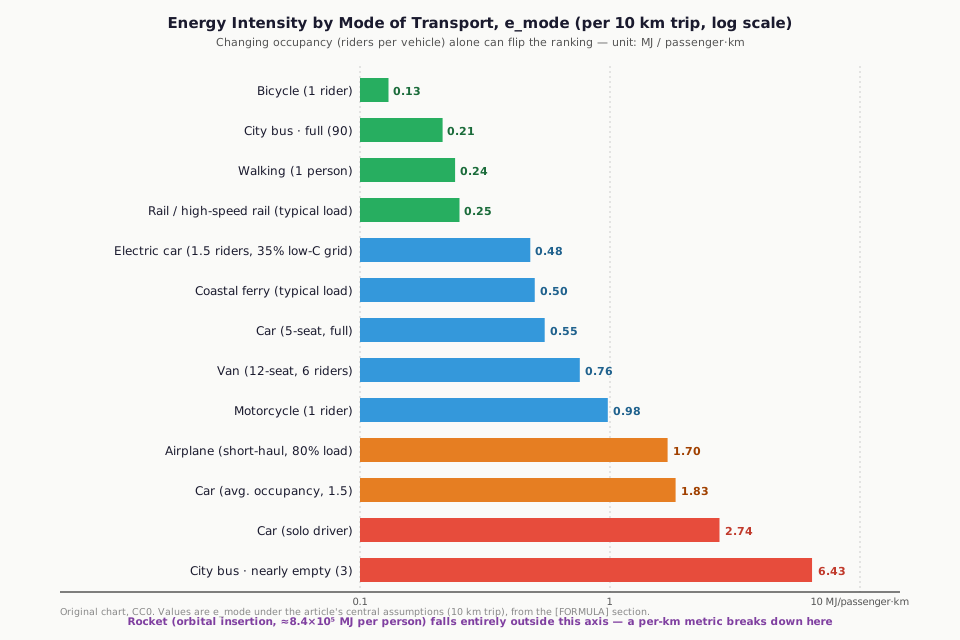
A 10 km commute by car uses far more energy per passenger than a bus — unless the bus is nearly empty. We break down energy intensity (MJ per passenger-km) across eleven transportation modes, from walking to electric cars to rockets, then apply it to one real trip — New York to Los Angeles, about 3,940 km (2,450 mi) — to see which one actually wins, and how badly occupancy and grid mix can reverse the rankings.

How Many People Are Awake Right Now? And When Are the Most People Awake?

How Many People Are Awake Right Now? And When Are the Most People Awake?

By mapping 8.11 billion people across 26 UTC time zones and overlaying a sinusoidal sleep-wake model, we calculate the global wakefulness curve. The peak hits UTC 06:12 — London 6 a.m., New York 1 a.m. — at roughly 5.9 billion awake, because India and China together account for 39% of humanity. Even at the trough (UTC 18:12), 2.7 billion people are still up. The swing ratio is 2.2×.

The Math of Soulmates: 13,400× Harder Than the Lottery — or Basically Inevitable?

The Math of Soulmates: 13,400× Harder Than the Lottery — or Basically Inevitable?

Two numbers, two completely opposite stories. The odds that one specific person out of 109 billion historical humans is your pre-assigned partner: about 13,400 times worse than winning the lottery. The realistic expected count of compatible people you'll actually meet in a lifetime: roughly 50 — with the probability of meeting at least one rounding to 1.000.